AI Belongs in Your Dev Pipeline, Not Your Product
Why the companies winning with AI aren't the ones with chatbots—they're the ones shipping twice as fast
A few months ago, a product lead at a mid-market SaaS company told me about her team’s long, expensive slog to launch an “AI-powered” dashboard. They spent months wrangling data, tuning models, and building a feature that would predict churn and surface insights. The result? A widget that looked impressive in demos, but rarely changed what users actually did. Meanwhile, her backlog ballooned. Customers wanted core features faster, bugs fixed sooner, and the UI modernized. But most of her engineers were busy wrangling the AI “add-on.”
This pattern repeats across the industry. The last few years have been about embedding AI into existing products, hoping to sprinkle on some magic and get some hype revenue. But what if that’s missing the point entirely? What if the future of software development isn’t about making products “smarter,” but about using AI to build faster, with less? What if the real unlock is not the features AI adds for users, but the time it gives back to builders?
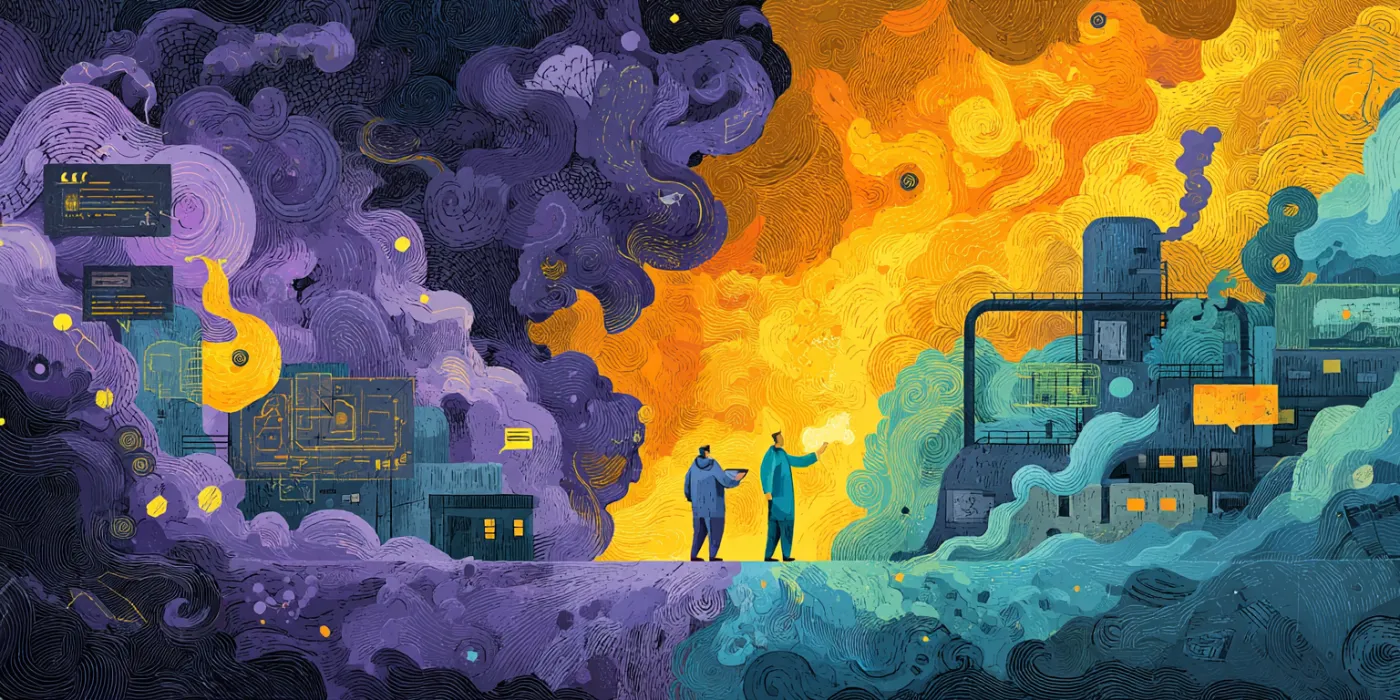
Speed Is the Feature: Why AI Belongs in the Factory, Not the Showroom
Everyone wants AI in their app: at least, that’s what the headlines and investor decks say. Add an AI button, a chatbot, some “insights,” and you’re future-proof, right? The reality is more sobering. Most companies struggle to integrate meaningful AI features, and even when they do, the user impact is often marginal. Meanwhile, development teams are drowning in technical debt, slow release cycles, and growing feature requests. We have a mountain of legacy technical debt and complexity in the real world, with already deployed applications, to fight against.
The real story is that AI’s biggest impact so far isn’t in the product - it’s in the process. Recent data shows that AI accelerates software development by up to 50%, with teams reporting 70% better bug detection and resolution. AI-driven automation in CI/CD pipelines enables 2.5 times more frequent deployments, slicing feedback loops and release times from weeks to days. This isn’t about smarter apps; it’s about faster, better builders.
Tools like GitHub Copilot, Cursor, and Claude Code have become co-developers instead of just autocomplete on steroids. They turn requirements or code stubs into working modules, automate boilerplate, refactor, and catch bugs before code reviews even start. The effect is cumulative: not only are you writing code faster, but you’re avoiding entire classes of human error, and spending more time designing features that actually matter. As case studies show, this shift shaves months off traditional timelines and lets smaller teams punch above their weight.
Organizations that learn to mitigate the downsides of AI-powered development workflows (like compounding technical debt, polluted codebases, and hallucinated data) are shipping real, unsexy features faster than their competitors.
The Rise of the AI-Native Factory Floor
The old model was “add AI to the product.” The new model is “let AI build the product.” This is not a subtle shift. In 2024, 75% of companies applied AI directly to their development workflows, not just as user-facing features. Over half cited task automation as the top reason, with code optimization, diagnostics, and testing close behind.
But the real inflection point is the emergence of AI-native development platforms and autonomous agents. Microsoft, IBM, and dozens of startups are building environments where AI isn’t an accessory but the primary tool. These platforms offer advanced code generation, real-time bug fixing, and multistep workflow automation. The most ambitious teams deploy autonomous agents that monitor live applications, optimize code, and fix bugs without human intervention.
Why does this matter? Because the bottleneck in software is rarely the absence of new ideas. It’s the time and cost to ship, adapt, and maintain those ideas. As AI-native platforms automate everything from requirement gathering to documentation, development becomes less about brute force and more about orchestration. The result: companies can build, iterate, and respond to the market with a fraction of the traditional headcount.
Human Judgment Still Sets the Destination
If AI is so capable, why not let it run the whole show? This is where the narrative gets more nuanced. AI excels at automating the repeatable, the tedious, the knowable. But it struggles with ambiguity, context, and the kind of judgment that shapes product vision. The most advanced tools still require skilled engineers to architect solutions, integrate data, and make strategic decisions.
There are also open questions about where to draw the line between AI autonomy and human oversight. Reliability, security, and ethical use are not solved problems. And as AI becomes more specialized and powerful, the risk of subtle bugs or unintended consequences rises. So yes, AI doubles your speed, but it still needs humans to choose the direction.
Still, this is not a limitation - it's an invitation to focus human talent where it matters. Imagine a world where your smartest engineers spend their time designing architectures, exploring new business models, or engaging customers, while AI sweeps away the friction of routine coding and deployment.
AI as Leverage, Not Just a Feature
There’s a counter-argument that says, “Won’t every competitor have access to the same AI tools, erasing any advantage?” But this misses the point. The advantage isn’t the tool - it’s the leverage. The companies that win will be those that treat AI as a multiplier for their unique talent and strategy, not as a checklist item for investors or a shiny add-on for users.
AI unlocks faster adaptation to market changes, more frequent releases, and higher customer satisfaction because the teams using it can out-iterate, out-learn, and out-deliver their rivals. In the same way that the assembly line transformed manufacturing, AI is transforming software by making scale and speed the default, not the exception.
Actionable Leverage: Three Moves to Make Now
1. Treat AI as Infrastructure, Not an Add-On
Shift budget and talent from AI features to AI-native development platforms. Invest in tools that automate your build, test, and deploy cycles. If you’re still treating AI like a product differentiator, you’re a step behind.
2. Reframe Developer Roles Around Judgment and Design
Free your engineers from boilerplate and bug-chasing. Let them focus on system design, product strategy, and customer engagement. Use AI to automate everything else that can be automated.
3. Measure Success by Cycle Time, Not Feature Count
Adopt deployment frequency, lead time, and customer responsiveness as your north stars. If your build times, release velocity, and feedback loops aren’t at least twice as fast as three years ago, you’re leaving leverage on the table.
The Future Is Built, Not Added
The biggest opportunities in software aren’t about what AI puts in the hands of users. They’re about what AI puts in the hands of builders. Companies that keep treating AI as a feature risk missing the real story: AI is the new factory floor. It’s how you build faster, cheaper, and smarter with the same or fewer people.
In the end, AI isn’t the “smart” feature your customers are waiting for. It’s the silent partner that lets you deliver the features they actually want, twice as fast. The future belongs to those who stop asking, “How do I add AI to my product?” and start asking, “How do I let AI build my product for me?” The difference, as always, is speed. And speed, in software, wins.
How did you like this article?
Enjoyed this article? Subscribe to get weekly insights on AI, technology strategy, and leadership. Completely free.
Subscribe for Free