The Simplicity Paradox
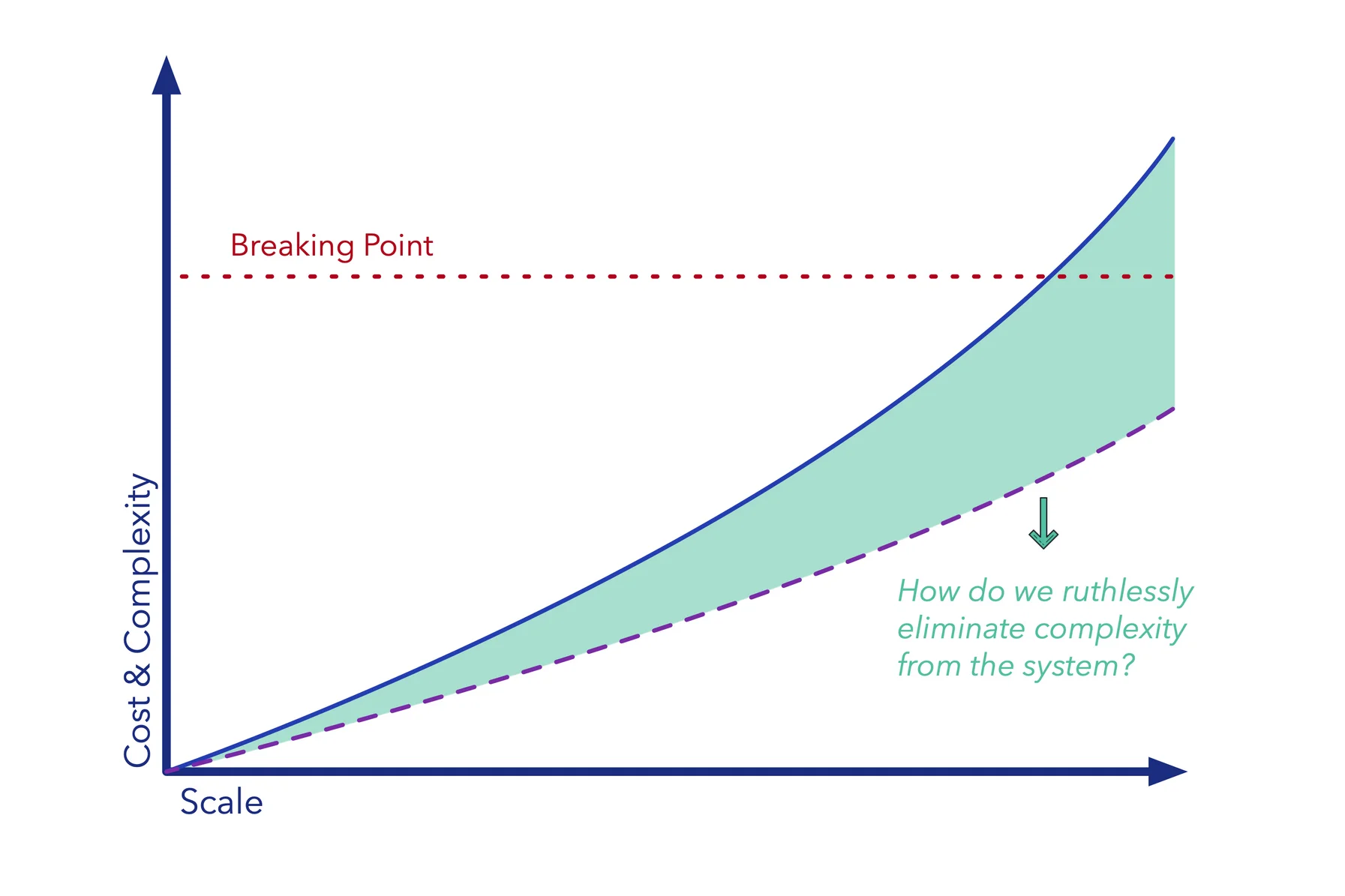
Complexity scales faster than revenue.
The Simplicity Paradox Sep 15, 2023
Imagine a snowball rolling down a hill. It starts small, but as it descends, it gathers more snow. But it's not just snow that's accumulating; twigs, leaves, and all kinds of debris get picked up as well.
This snowball mirrors your organization. While the goal is to scale revenue as you continue to roll downhill, gaining momentum, the added complexities baked into growth can turn an otherwise smooth ride into a wobbly descent.
Is your organization buckling under the weight of overcomplexity? If so, the key to sustainable growth might be simpler than you think.
The Exponential Cost of Complexity
In software engineering, there's a concept known as the "Rule of Ten," suggesting that the cost to fix a bug increases by an order of magnitude at each stage of the development cycle. The longer you wait to fix something, the more complex - and costly - the fix becomes. Worse, sometimes fixing problems introduces regression defects, breaking another part of the system.
As your organization scales, the cost of complexity grows by multiples, often faster than the revenue it's designed to generate. Each new team member exponentially increases the complexity of interactions. Every new tool brings training and integration costs that are rarely planned for.
The more complex the environment, the steeper the learning curve. Onboarding becomes a lengthy and complicated process, slowing down the time it takes for new hires to become fully productive members of the team.
Similarly, as new products or services are added, every member of your sales team needs to understand them to sell effectively. The cognitive load increases, not linearly, but exponentially as your offerings grow in complexity. It's not just hard for them; it's harder for your customers to understand, too.
Amidst a labyrinth of processes, employees can often feel like mice in a maze, endlessly scurrying but rarely finding the cheese. The spiraling complexity not only dilutes focus but also erodes morale. When the playbook is too intricate, it doesn't just slow down decision-making; it can lead to decision paralysis, where team members feel overwhelmed by the sheer number of variables they need to consider. The emotional toll is subtle but corrosive.
The snowball keeps picking up junk. The longer complexity is left un-addressed, the more painful it is to reduce.
To have a fighting chance at success, we must aim for the Minimum Viable Complexity (MVC) within the organization. What's the simplest configuration that achieves revenue goals without excess baggage? What can we ruthlessly cut from our organization to keep things simple and running smoothly without sacrificing our values or objectives?
Simplify to Amplify
"If parts are not being added back into the design at least 10% of the time, [it means that] not enough parts are being deleted. The bias tends to be very strongly toward 'let's add this part or process step in case we need it." -Elon Musk
The drive for simplicity must be a part of organizational culture, at all levels. As sales leaders, we must ruthlessly eliminate as much complexity from the system as possible - sometimes deleting pieces of our organization that might hurt, but will ultimately lead to improved efficiency over time. The best leaders seek this balance continually.
Even the most intricate of symphonies are built on simple scales. Musicians know that mastery begins with understanding the basics deeply. Likewise, mastering the scale of your revenue growth is best achieved by understanding and optimizing your basic structures, processes, and activities.
1. Prune Inefficient Processes
- Concept: Think of your organization as a tree. Just as a tree needs pruning to grow healthily, your organization needs regular trimming of inefficiencies.
- Action Step: Adopt a "Minimum Viable Complexity" (MVC) model, where you continually reassess and define the least complex system that still meets your objectives. This will help you remove redundant meetings, overlapping roles, and outdated procedures.
2. Enhance Communication
- Concept: Current "status quo" corporate communication overwhelms, stresses out, and bores employees.
- Action Step: Simplify internal communications. Speak like a human and use the right channel for the right message. Use the same concepts that target customers.
3. Embrace Feedback
- Concept: The solutions to most of your problems are already floating around in the heads of your employees, waiting to be discovered. Ask the people who feel the friction what should be done to make things better.
- Action Step: Establish regular retrospectives to understand what the organization should collectively keep doing, start doing, or stop doing. The people closest to the problem will have the best insights.
4. Reward Experimentation
- Concept: You probably aren't going to get it right the first time (or fifth). Addressing complexity is difficult. Experimentation + adaptation is the only way to move forward.
- Action Step: Track hypothesis and decisions from the feedback sessions. Create or delete structures, processes, and tools in a gesture towards wholesale improvement. Keep what works, kill what doesn't - reward those who try to improve things.
5. Implement Regular Complexity Audits
- Concept: Organizations are living systems that grow and change. What was effective six months ago may not be so today.
- Action Step: Schedule regular "audit checkpoints" where the leadership team assesses the current state of organizational complexity. Use these audits to make real-time adjustments, thereby ensuring your company remains agile and focused on its core mission.
BONUS: Eliminate Naval Gazing
- Concept: If incentivized, members of an organization will focus internally on initiatives, committees, and projects that do not add value to the customer.
- Action Step: Focus on what matters. Publicly reward excellence in the behaviors that drive value to the organization and its customers. Eliminate internal initiatives that no longer make sense or serve as a path of least resistance to distract people's efforts.
The paradox: to grow more, you might have to do less. Keep it simple, and let that simplicity be the catalyst that amplifies your sustainable growth.
By integrating these strategies into your organization's operations, you'll be well-equipped to manage complexity effectively. Remember, the goal is not just to grow, but to grow sustainably. Keep it simple, and let that simplicity be the catalyst for your success.
Simplicity as Your Growth Catalyst
As your organization scales, remember that the snowball's core - your fundamental business model - should remain solid and straightforward. While complexity is an inevitable part of growth, unchecked complexity is the silent killer of sustainable scaling.
The secret to long-term success lies in finding that perfect equilibrium where your operations are as streamlined as possible, yet as complex as necessary. To navigate this balance, regularly prune inefficient processes, enhance communication, embrace employee feedback, reward experimentation, and conduct frequent complexity audits. Master these strategies, and you won't just grow; you'll flourish sustainably.